
Alfresco Hosting on MassiveGRID PaaS
Alfresco is an open-source enterprise content management (ECM) platform for storing, versioning, searching and governing documents at scale. The MassiveGRID PaaS package deploys Alfresco Community Edition with its Java application server and database in one click, giving you a private document repository you fully control.
Alfresco on MassiveGRID PaaS installs in one click in New York, London, Frankfurt or Singapore, costs about $98.40 a month for the Starter configuration, a Java application server (4 GiB) and a Relational database (1 GiB), and starts with a 14-day free trial. See the sizing table.
Both buttons open the MassiveGRID PaaS dashboard with Alfresco pre-selected. Sign up without a card, name the environment, pick a region, and the package installs in a few minutes.
Alfresco Package Facts
| Attribute | Value |
|---|---|
| Package | Alfresco |
| Type | Application (installs a complete environment) |
| Category | Websites & CMS |
| Software vendor / project | Hyland (Alfresco Community Edition) |
| Licence | LGPLv3 (Community Edition, open source) |
| Runtime / stack | Java application server (Tomcat), relational database, Alfresco Content Services Community Edition |
| Regions | New York, London, Frankfurt, Singapore |
| Billing | Pay-per-use, about $98.40/month for the Starter configuration (40 cloudlets at $0.003372 per cloudlet-hour), no licence fee |
| Free trial | 14 days, no credit card |
| Uptime SLA | 100% |
What is Alfresco?
Alfresco Content Services is a document repository built to the CMIS standard, with versioning, metadata, full-text search, workflow and records-management features that consumer file-sharing tools lack. Organisations use it as the system of record for contracts, engineering drawings, case files and policies, integrating it with Microsoft Office, Google Docs and line-of-business applications through its REST APIs.
It is also a demanding Java application to run. The marketplace package deploys the Alfresco repository on a Tomcat application server with a relational database, sized so that the Java heap and search index have room to work. Vertical auto-scaling then lets the environment grow as your document volume and user count increase.
What the Alfresco Package Deploys
Marketplace packages are not bare container images. One click provisions a complete, production-shaped environment on MassiveGRID infrastructure. How these nodes are sized and what they cost.
- Java application server: Tomcat running the Alfresco repository and Share web client, with JVM memory limits tied to the allocated cloudlets.
- Relational database: A database container for Alfresco's metadata, configured and linked during installation.
- Content store: Persistent storage for the binary content of documents, with platform snapshots for recovery.
- Built-in domain and SSL: HTTPS access to the Share interface and REST API from the first minute.
What Alfresco Costs to Run
Three starting configurations for the Alfresco package, sized in cloudlets (1 cloudlet = 128 MiB RAM + 400 MHz CPU) and priced at the published rate of $0.003372 per cloudlet-hour, or $2.46 per cloudlet-month. Java content platforms of this size are usually run with 4 GiB or more for the JVM, so even the Starter row allocates 32 cloudlets to it; check the vendor's current requirements for the release you deploy.
| Configuration | Topology | Cloudlets | Est. per month |
|---|---|---|---|
| StarterEvaluation and small teams | Java application server (32 cloudlets, 4 GiB), Relational database (8 cloudlets, 1 GiB) | 40 | $98.40 |
| StandardA team in daily use | Java application server (48 cloudlets, 6 GiB), Relational database (16 cloudlets, 2 GiB) | 64 | $157.44 |
| ProductionHigh traffic, scaled horizontally | NGINX load balancer (4 cloudlets, 512 MiB), 2 × Java application server (48 cloudlets, 6 GiB each), Relational database (24 cloudlets, 3 GiB) | 124 | $305.04 |
Estimates assume the environment averages the listed cloudlets around the clock; billing is hourly, vertical auto-scaling lowers the figure when the application is idle, and volume discounts apply as usage grows. Disk and external traffic are billed per gigabyte on top. No licence fee applies to the package. Pick a row in the installer by setting the cloudlet limits per node, or start small and let auto-scaling grow it. Price a different topology or a working-hours schedule in the PaaS pricing calculator; the PaaS page describes the billing model.
Why Teams Choose Alfresco
Enterprise document management
Versioning, check-in/check-out, metadata, rules and full-text search over PDFs, Office files and images.
Open standards
CMIS, REST and WebDAV interfaces integrate Alfresco with existing applications and avoid vendor lock-in.
Workflow and governance
Built-in process engine for review and approval flows, plus audit trails suited to compliance needs.
Data sovereignty
Keep the repository in New York, London, Frankfurt or Singapore and know exactly where regulated documents live.
How to Install Alfresco on MassiveGRID PaaS
Installing the package takes three steps and a few minutes of waiting. No servers to provision, no configuration files to edit.
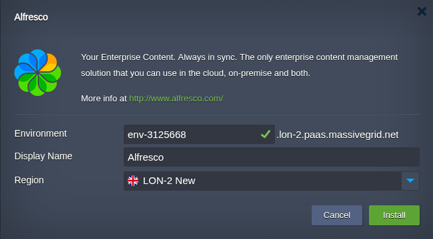
Open the installer
Click Install with free trial or Install to my account. The MassiveGRID PaaS dashboard opens with the Alfresco package pre-selected, so nothing has to be copied or pasted.
Sign up or sign in
New to the platform? Sign up for the free 14-day trial, which needs no credit card. Existing customers sign in with their usual dashboard credentials.
Choose region and deploy
Name the environment, pick New York, London, Frankfurt or Singapore, and confirm. The platform builds every Alfresco node, wires them together and hands you the live URL and credentials.
Who Runs Alfresco on PaaS
Legal and professional services
Firms that need a versioned, auditable repository for contracts and case files.
Engineering and manufacturing
Controlled document management for drawings, specifications and quality records.
Public sector
Agencies with records-retention obligations that want an open-source system in a chosen jurisdiction.
Why Run Alfresco on MassiveGRID PaaS
Built for uptime. Alfresco runs on MassiveGRID's high-availability platform, where every environment is covered by a 100% uptime SLA. Nodes live on redundant hosts, storage is replicated, and failed containers are restarted or migrated automatically.
Pay for what you use. Billing is hourly and per cloudlet (128 MiB RAM plus 400 MHz CPU). Vertical auto-scaling adds and removes cloudlets as load changes, so a quiet Alfresco environment costs a few dollars a month and a busy one grows without a migration. Full details are on the PaaS page.
Your choice of jurisdiction. Deploy in New York, London, Frankfurt or Singapore and keep data inside the region your users or regulators require. MassiveGRID is ISO 27001 and ISO 9001 certified and GDPR compliant, and has run hosting infrastructure since 2003.
No lock-in. The package is a standard Jelastic Packaging Standard (JPS) manifest. You keep root-level access to the containers, can export the manifest, and can move the workload to any other Jelastic-compatible platform or to your own servers at any time.
Related on massivegrid.com: Platform as a Service · GDPR Compliance.
Alfresco Questions
Alfresco Guides from the MassiveGRID Blog
Alfresco is covered in these comparison guides and roundups, alongside the packages it is usually deployed with. Browse the blog.
More from the Marketplace
Packages that are often deployed alongside Alfresco, or that solve the same problem a different way. Browse all 83 packages.


Deploy Alfresco Today
Start the free 14-day trial and have Alfresco running in minutes. No credit card required.